What to Look for in a U.S. Research Peptide Supplier
Article Intro
Selecting a U.S. research peptide supplier requires evaluating documentation, not just pricing. Prioritize lot-specific certificates of analysis with HPLC purity data and mass spectrometry identity confirmation. Verify clear research-only labeling, traceable packaging, and transparent shipping policies. Avoid suppliers making therapeutic claims or lacking batch-level records. The right supplier reduces experimental uncertainty through verifiable quality systems.
Choosing a U.S. research peptide supplier is not just a matter of comparing prices or scanning a catalog for familiar product names. For laboratories, independent research teams, universities, and private R&D groups, the supplier is part of the research workflow. A weak supplier can introduce avoidable uncertainty before an experiment even begins. A strong supplier supports traceability, documentation, consistent handling, and clear boundaries around intended use. The best choice is usually the company that makes it easiest to verify what was ordered, what batch was received, how it was tested, how it was packaged, and what claims are not being made.
This matters because peptides are chemically specific materials. A peptide is generally understood as a short chain of amino acids linked by peptide bonds, a basic definition that can be reviewed in neutral scientific references such as the Wikipedia overview of peptides. In real research purchasing, however, the word "peptide" is only the start. The practical questions are more detailed: What is the exact sequence? What salt form or modification is specified? What analytical method was used to confirm identity? What purity threshold is documented? Is the certificate of analysis available before purchase or only after a problem arises? How does the supplier describe storage and shipping conditions? Does the website avoid consumer-style therapeutic language?
A supplier that serves the research market should behave like a documentation partner, not like a lifestyle brand. The website should make clear that the materials are intended for laboratory research only, not human use, veterinary use, diagnostic use, or self-experimentation. The product pages should describe research materials in a disciplined way, with lot numbers, testing references, storage guidance, and limitations. The support team should be able to answer process questions without drifting into medical, dosing, or outcome claims. In short, a reliable supplier helps researchers reduce ambiguity. It does not create more of it.
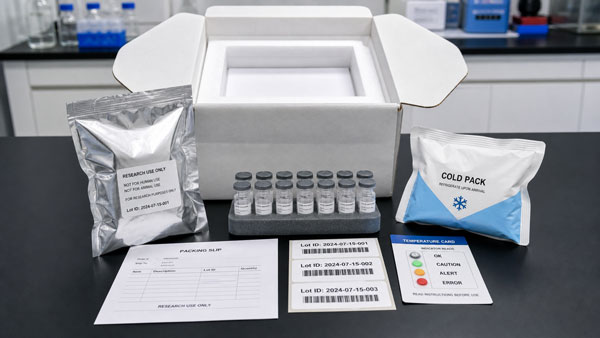
A credible research peptide supplier should make batch documentation, identity testing, and purity records easy to review.
Start with Intended Use and Compliance Language
The first signal to check is the supplier's language around intended use. A research peptide supplier should use clear research-only terminology and avoid claims that imply treatment, prevention, diagnosis, body transformation, performance enhancement, or personal health benefits. If the site reads like a supplement store or clinic brochure, that is a warning sign. Research materials should be framed around in-vitro investigation, analytical work, assay development, or controlled laboratory contexts. The supplier should not provide dosing instructions, personal-use protocols, or medical advice.
The United States regulatory environment draws important distinctions between research-use materials and products intended for clinical, diagnostic, or therapeutic use. One helpful point of reference is the FDA's guidance on research use only and investigational use only products. That guidance is written for in-vitro diagnostic products, so it should not be treated as a direct rulebook for every peptide material, but it is still useful because it shows how seriously intended use, labeling, and marketing context matter. A supplier that understands research boundaries will keep those boundaries visible across product pages, invoices, packing slips, and customer support language.
A good website will also avoid vague disclaimers that appear only in a footer. The research-use limitation should be visible where buying decisions are made. Product descriptions should not contradict the disclaimer with consumer promises. FAQ sections should not answer personal health questions. Email support should not offer advice that would be inappropriate for a research reagent supplier. Consistency is the point. If the supplier says "research only" in one place and then markets the same materials as personal wellness products elsewhere, the buyer should pause.
Look for Lot-Level Certificates of Analysis
A certificate of analysis, often called a COA, is one of the most important documents in research peptide purchasing. A useful COA should be tied to a specific lot or batch, not just to a general product name. It should identify the peptide, provide a batch identifier, show the date of analysis or release, and summarize the methods used to assess purity and identity. A generic PDF with no lot number, no method detail, and no analytical trace should not carry much weight.
The best suppliers make COAs easy to find before purchase. Public COA libraries or batch lookup pages are especially helpful because they let a buyer evaluate transparency without needing to email a sales desk. For example, Apex Lab positions its research peptide offering around public documentation, batch testing, HPLC purity analysis, mass spectrometry identity confirmation, and research-only use. Whether evaluating Apex Lab or any other supplier, the same principle applies: do not rely only on marketing claims when analytical records should be available.
Researchers should also check whether the COA matches the exact product being purchased. Product names can be similar, and some peptides are sold in multiple vial sizes, salt forms, or modified versions. The lot number on the vial, the packing slip, and the COA should align. If a supplier cannot explain how to connect a received vial to its analytical record, the documentation system is not mature enough for serious research procurement.
Understand Purity Testing, Not Just Purity Claims
Many suppliers advertise purity percentages, often 98 percent or 99 percent and above. The number matters, but the method behind the number matters more. High-performance liquid chromatography, commonly abbreviated as HPLC, is widely used to estimate peptide purity by separating components and measuring peak areas. A clean, dominant peak can support a purity claim, but the chromatogram, method, retention time, and integration approach all provide context. A supplier that only states "99 percent pure" without showing how that figure was reached is asking the buyer to accept a conclusion without the evidence.
Mass spectrometry, often reported as MS or ESI-MS, is typically used to confirm molecular identity by comparing the observed mass with the expected molecular mass. This is different from purity. A material can have the correct main mass and still contain process-related impurities. Conversely, a purity report without identity confirmation leaves another gap. For research use, the strongest documentation usually includes both purity analysis and identity confirmation. The records do not need to be visually beautiful, but they should be specific, legible, and tied to a batch.
It is also useful to distinguish between supplier-performed testing and independent or third-party testing. Internal testing can be legitimate, especially when a supplier has a robust quality system, but third-party confirmation adds confidence because it reduces the chance that quality claims are being made without outside verification. The buyer should not assume that every "tested" claim means the same thing. Ask what was tested, by whom, using which method, and whether the original data can be reviewed.
Evaluate Traceability from Order to Bench
Traceability is the ability to follow a material from product listing to order, shipment, receipt, storage, and use in the lab. A research peptide supplier should support this chain with practical identifiers. Product pages should list the peptide name and relevant specifications. Vials should carry labels that identify the product and lot. Packing slips should show enough detail to reconcile the shipment with the order. COAs should connect to the lot number. If the lab later needs to review experimental results, troubleshoot an unexpected outcome, or document materials used in a study, these connections become important.
Traceability is not just a paperwork concern. It helps protect experiments from avoidable confusion. If two vials arrive with similar names but unclear labels, a simple receiving error can compromise weeks of work. If a supplier changes batches without notifying customers, repeat experiments may become harder to interpret. If documentation is only provided after repeated requests, the procurement process slows down. A serious supplier designs the customer experience around reducing those risks.
A buyer can test a supplier's traceability before placing a large order. Look for sample COAs. Review the product page format. Check whether lot numbers are discussed in the FAQ. Ask a support question about how batch records are connected to shipments. The answer should be straightforward. If the reply is evasive or purely promotional, treat that as a procurement signal.
Inspect Packaging and Shipping Practices
Peptides are commonly shipped as lyophilized powders in sealed vials, although formats vary by product and supplier. The practical packaging question is whether the supplier protects the material from breakage, heat exposure, moisture, and confusion during transit. Vials should be secured so they do not rattle loosely in a box. Labels should remain readable. The outer package should include enough protection for normal carrier handling. When temperature sensitivity is relevant, the supplier should describe how it uses insulation, cold packs, or seasonal shipping adjustments.
Packaging should support traceability, temperature awareness, and safe laboratory receiving procedures.
Shipping speed is only one part of the decision. A fast shipment that arrives poorly labeled or poorly protected is not a quality experience. Buyers should look for clear shipping policies, tracking information, estimated handling windows, and realistic language about delivery conditions. If the supplier ships only within the United States, that should be stated clearly. If cold packs are used only during warm weather or above certain temperature thresholds, that should also be explained. The more specific the policy, the easier it is for a lab to plan receiving and storage.
Good packaging also supports internal lab procedures. A receiving technician should be able to check the shipment against the packing slip, confirm that vial labels match the order, note any temperature indicator, and place the material into appropriate storage without guessing. Suppliers that think this way are more likely to understand the operational needs of research customers.
Review Storage, Handling, and Reconstitution Guidance Carefully
Research suppliers often provide general storage and handling guidance. That guidance should be practical but limited. It may cover refrigeration, freezing, protection from light, desiccation, or handling of lyophilized material. It may explain that reconstitution choices depend on the research protocol and laboratory validation. It should not shift into personal-use instructions. A supplier can help researchers understand material handling without telling individuals how to use a compound on themselves or others.
The best suppliers separate general material information from protocol decisions. For example, they may provide molecular weight, sequence, purity, and storage notes, while leaving experimental design to the qualified laboratory team. That distinction protects both the supplier and the researcher. It also makes the information more useful because it stays focused on the material rather than unsupported outcomes.
A reconstitution calculator can be useful when it performs basic concentration math for laboratory planning, but it should not be wrapped in dosing claims or consumer instructions. Buyers should look at the surrounding language. Is the tool framed as a lab calculation aid, or does it imply personal administration? Responsible suppliers keep the context scientific and limited.
Compare Catalog Breadth with Documentation Depth
A large catalog can be convenient, but it is not automatically a quality signal. Some suppliers list many compounds while providing thin documentation for each one. Others carry a smaller catalog but maintain better batch records, clearer labels, and stronger support. For research procurement, documentation depth often matters more than catalog size. A lab needs confidence in the specific vial it receives, not just a long menu of product names.
When comparing suppliers, open several product pages and check whether the same quality standard appears across the catalog. Are COAs available for only popular products, or for all current lots? Are the product pages structured consistently? Are storage and research-only statements repeated where needed? Are out-of-stock items handled transparently, or does the site continue to accept orders without clear fulfillment timing? These operational details reveal whether the supplier has a disciplined process behind the storefront.
Researchers should also watch for exaggerated product descriptions. A peptide can be important in published research without being appropriate for broad consumer claims. A supplier that summarizes research context carefully is different from one that converts every compound into a promised result. The former is more aligned with laboratory purchasing. The latter creates risk.
Check Company Transparency and Customer Support
A U.S. supplier should provide basic business transparency. Look for a real contact method, clear policies, shipping information, refund or issue-resolution terms, and a professional support channel. The company does not need to publish every internal detail, but it should be reachable and consistent. If there is no company information, no address context, no support policy, and no documentation trail, the buyer is taking on unnecessary risk.
Support quality is especially important when a shipment arrives with a damaged vial, a missing document, or a question about lot identification. A good support team can resolve order and documentation issues quickly. It should be able to provide COAs, clarify packaging, confirm whether an item is from a particular batch, and explain shipping status. It should not provide medical advice, personal-use guidance, or claims about outcomes.
Before placing a significant order, it can be worth sending a simple documentation question. Ask how to find the COA for a current lot, how vials are labeled, or how the supplier handles warm-weather shipping. The response will often tell you more than a polished homepage. Clear, specific answers suggest an organized operation. Vague answers suggest that the supplier may not have the process maturity a research lab needs.
Use Price as a Signal, Not the Main Decision
Price matters, especially for repeated experiments or multi-peptide studies. But the lowest price is not always the lowest cost. Poor documentation, delayed shipments, unclear batches, weak packaging, or inconsistent quality can cost more through failed runs, repeated work, and procurement delays. A supplier that charges slightly more but provides reliable COAs, traceable lots, and responsive support may be the more economical choice over time.
Extreme discounts should be evaluated carefully. There may be legitimate reasons for sale pricing, such as inventory rotation or promotional periods, but very low prices combined with missing documentation should raise concern. Research materials require synthesis, purification, testing, packaging, and controlled handling. If the price appears disconnected from those realities, ask what is being omitted.
The best comparison method is to build a short supplier scorecard. Include documentation access, lot traceability, analytical methods, product labeling, packaging, shipping clarity, support quality, compliance language, and price. This prevents the decision from being dominated by one attractive number. It also creates a repeatable procurement standard for future orders.
Watch for Red Flags
Several warning signs should slow down a purchase. The most obvious is therapeutic marketing. If a site selling research peptides makes direct promises about weight loss, healing, anti-aging, athletic performance, or disease treatment, it is not behaving like a careful research supplier. Another warning sign is missing or generic COAs. A third is a refusal to connect a shipped vial with a specific lot record. Poor labeling, no shipping policy, no support channel, and inconsistent product names are also concerns.
Researchers should also be cautious when a supplier hides behind technical language without providing actual documents. Words such as "premium," "pharmaceutical grade," "lab tested," and "high purity" can be useful only if they are supported by records. Without records, they are marketing terms. Quality claims should be verifiable. If they are not, they should not drive the purchase.
Another red flag is operational opacity. If order timing is unclear, if support responses are inconsistent, if policies conflict across the website, or if the supplier changes claims frequently, the buyer may face the same confusion after payment. Procurement should reduce uncertainty, not add another uncontrolled variable to the research process.
A Practical Supplier Checklist
A reliable U.S. research peptide supplier should meet several practical standards. It should state research-only intended use clearly and consistently. It should provide lot-specific COAs with meaningful analytical information. It should use appropriate methods such as HPLC for purity and mass spectrometry for identity when relevant. It should label products clearly, connect shipments to batches, and make support available for documentation questions. It should package vials to prevent breakage and support temperature-aware receiving. It should publish policies that are specific enough for a laboratory to plan around.
The supplier should also show restraint. Responsible research suppliers do not need dramatic promises. They do not need to imply clinical effects. They do not need to encourage personal use. Their strongest selling points are process, documentation, consistency, and transparency. Those features may sound less exciting than consumer marketing claims, but they are exactly what research buyers need.
When in doubt, choose the supplier that makes verification easiest. Can you review the COA? Can you identify the lot? Can you understand the packaging? Can you reach support? Can you tell what the product is and what it is not intended for? If the answer is yes across those areas, the supplier is more likely to support reliable research purchasing.
Wrapping up
The right U.S. research peptide supplier is not simply the one with the broadest catalog or the boldest purity claim. It is the one that treats every order as part of a documented research workflow. That means clear intended-use language, batch-specific analytical records, traceable labels, practical packaging, realistic shipping policies, and support that stays within appropriate scientific boundaries. These qualities do not guarantee the outcome of any experiment, but they reduce preventable uncertainty around the materials themselves.
A careful buyer should therefore evaluate suppliers the same way a careful researcher evaluates data: by looking for evidence, consistency, and context. Marketing can introduce a company, but documentation should carry the decision. When a supplier makes quality easy to verify and compliance boundaries easy to understand, it gives researchers a better foundation for planning, receiving, storing, and documenting their materials.
For laboratories and research teams, that foundation is worth protecting. Peptide research already contains enough scientific complexity. Supplier uncertainty should not be added to the list.